
The New Wealth Crisis
- Sonia Brown MBE

- May 25
- 9 min read
Why So Many Men Look Successful but Feel Spiritually Bankrupt
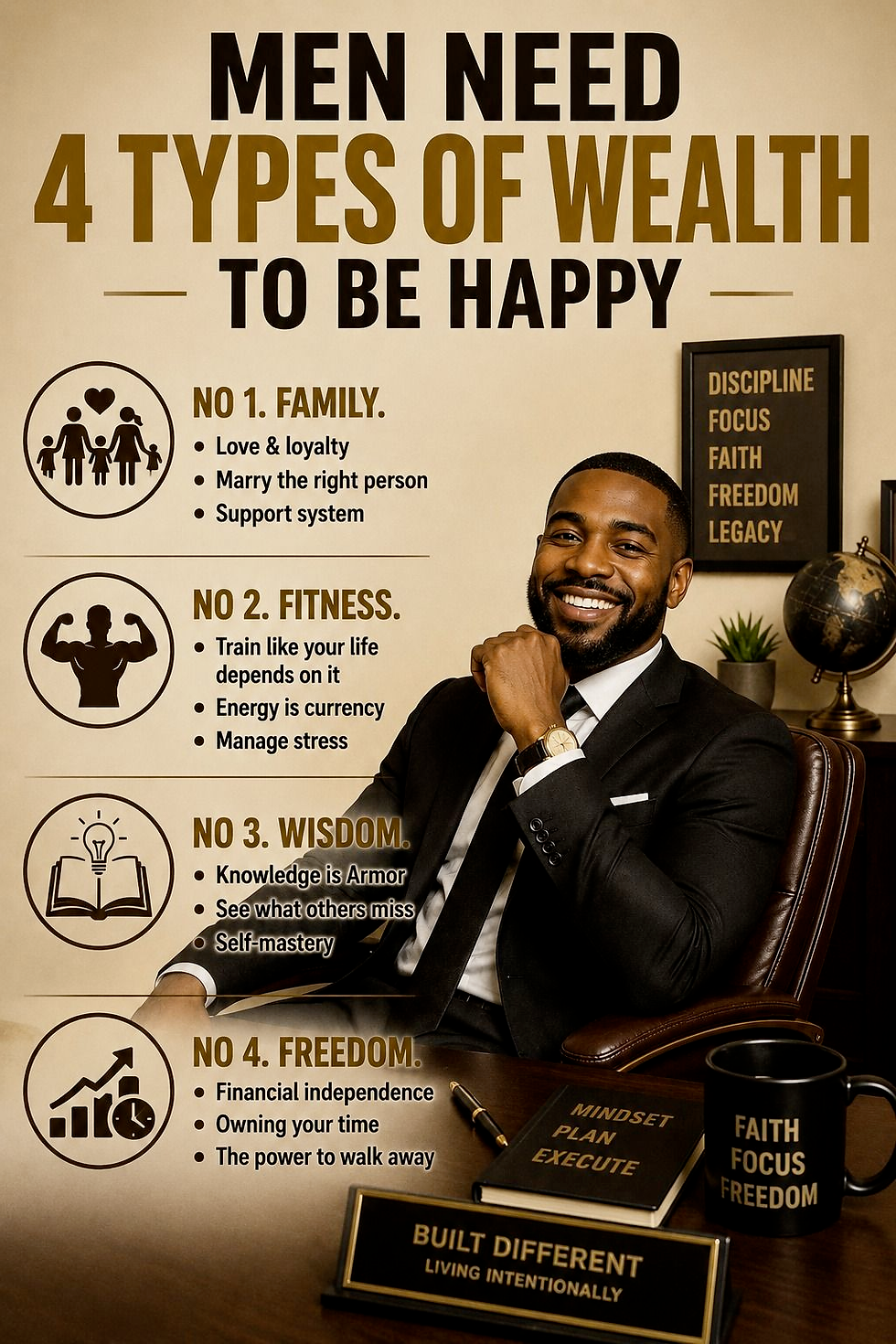
There is a reason images like the one shared by #lifehackscoach are spreading so rapidly across social media.
Not because men suddenly discovered discipline, fitness or family values. Those conversations have existed for generations, passed down through fathers trying to prepare sons for survival, through barbershop debates about responsibility and respect, through faith leaders preaching discipline and purpose and through communities where manhood was often measured by resilience under pressure.
What has changed is not the existence of the conversation, but the urgency behind it.
Today, many men sense that something deeper is breaking beneath modern life. Workplaces feel more unstable. Relationships feel more fragile. Identity feels increasingly performative. Health feels harder to maintain. In that environment, words such as “freedom,” “legacy,” “self-mastery” and “own your time” no longer sound old-fashioned.
They sound necessary.
The image resonates because it captures a growing emotional exhaustion hidden beneath modern success culture. For decades, success was sold through visible symbols. The suit, the watch, the title, the car, the ability to provide financially without appearing emotionally vulnerable.
Yet beneath that polished exterior, many men are quietly wrestling with burnout, loneliness, financial anxiety, fractured relationships and declining health. Achievement without peace is beginning to feel like an empty transaction.
Les Brown often reminded audiences that most people fail not because they aim too high and miss, but because they aim too low and hit.
Yet modern culture created generations of men who were taught how to pursue income, but not necessarily how to protect emotional stability, purpose or psychological wellbeing. Similarly, Myles Munroe frequently separated success from significance, warning that achievement without purpose eventually leaves people spiritually empty.
That tension is now becoming increasingly visible across workplaces, relationships, wellness culture and online identity movements.
The rise of artificial intelligence, economic uncertainty, social media comparison culture and declining trust in institutions is forcing many people to rethink what wealth actually means.
Increasingly, people are recognising that someone can be financially successful while emotionally depleted, socially connected while spiritually disconnected and publicly admired while privately exhausted.
Even Marcus Garvey understood that liberation required more than economics. It required identity, ownership, dignity and self-definition. In many ways, today’s conversations around freedom echo older struggles around autonomy and survival, only now they are being played out through burnout culture, digital dependency, fractured relationships and emotional instability.
The deeper issue is this. Many men are no longer simply trying to become wealthy. They are trying to become psychologically safe in an increasingly unstable world.
Which brings us to the seven major trends reshaping the workplace, business landscape, relationships, health and identity in modern society today.

1. Men Are Reframing Success Away From Status Alone
For decades, masculinity was closely tied to visible achievement. Men were taught that their value rested in income, status, performance and endurance.
Success became external, measurable and publicly validated.
Yet beneath that model sat an uncomfortable reality. Many men were silently collapsing while appearing successful on the surface.
That conversation is now changing.
Increasingly, men are questioning whether traditional success has come at too high a cost. There is a growing shift away from performative wealth and toward emotional stability, health, autonomy and psychological peace.
The language used in the image reflects this transition clearly.
“Freedom,” “discipline,” “family” and “self-mastery” suggest that many men are no longer simply pursuing status. They are searching for meaning and inner security in a world that feels increasingly unstable.
Research from Gallup, the World Health Organisation and the Office for National Statistics (ONS) continues to show rising levels of stress, loneliness and emotional exhaustion among men. At the same time, social media intensifies comparison culture, exposing men to unrealistic standards of success while rewarding performance over authenticity.
Bell Hooks argued in ‘The Will to Change’ that many men are socialised to suppress vulnerability in exchange for social approval and masculine acceptance. That emotional suppression often leaves men isolated, emotionally disconnected and unable to experience deeper forms of healing or intimacy.
Similarly, Na'im Akbar challenged narrow ideas of manhood rooted purely in dominance or survival, arguing instead for a more holistic understanding of purpose, consciousness and emotional wellbeing.
This is why many men are redefining wealth itself. Wealth is increasingly being measured not simply through money, but through peace of mind, freedom of time, trusted relationships, physical vitality and emotional regulation.
2. The Race for Progress: Over-Disciplined and Emotionally Exhausted
One of the most revealing aspects of the image is its obsession with discipline, structure and optimisation. For many men, especially Black men, discipline is not simply aspirational. It becomes protective.
In environments where mistakes are judged more harshly and competence is constantly questioned, many Black men learn they must work twice as hard simply to be perceived as equal.
The result is often hyper-vigilance, hyper-performance and emotional suppression that may appear impressive externally, but internally produces exhaustion.
This dynamic is particularly visible within institutions such as the police service, military and corporate leadership structures. While these institutions publicly promote diversity and inclusion, many Black men continue to report experiences shaped by microaggressions, stereotype threat and constant scrutiny.
Research from McKinsey & Company has repeatedly highlighted progression barriers faced by Black professionals navigating predominantly white leadership environments. Black professionals often experience heightened scrutiny, reduced sponsorship opportunities and unequal perceptions around professionalism and leadership potential.
Scholar William A. Smith described this cumulative stress as “racial battle fatigue,” referring to the psychological and physiological toll of constant racial vigilance and microaggressions. Over time, this can contribute to anxiety, emotional exhaustion, elevated cortisol levels and long-term health consequences.
This helps explain why conversations around fitness, self-mastery and control have become so emotionally charged online. For many men, particularly Black men operating within high-pressure systems, control over the body becomes symbolic of control over life itself. The gym becomes therapy, armour and emotional release.
3. Relationships Are Undergoing a Massive Recalibration
The image places “marry the right person,” “loyalty” and “support system” alongside wealth and discipline because relationships are increasingly being viewed through the lens of peace, stability and survival.
For many men and women, partnership is no longer assessed purely through romance. It is increasingly evaluated through emotional safety, financial consequence and long-term sustainability. The question is no longer simply, “Do I love this person?” but “Can I build safely with this person?”
The data reflects this shift. The Office for National Statistics (ONS) recorded more than 103,000 divorces and civil partnership dissolutions in England and Wales in 2023, while cohabiting families continue to rise.
At the same time, the financial cost of divorce has become increasingly severe. Research from Aviva estimated average divorce and separation costs at over £14,500 before accounting for property, housing and lifestyle disruption.
There is also growing concern around “grey divorce” among adults aged 50 and over. Research published in The Journals of Gerontology suggests later-life divorce carries significant emotional, financial and mental health implications, including increased loneliness and antidepressant use.
This is why relationships feel increasingly tense. Men are being told to build wealth, protect peace and stay disciplined, while women are simultaneously reassessing emotional labour, ambition compatibility and financial independence. Both sides are renegotiating expectations at the same time.
4. Health Has Become the New Wealth Infrastructure
One of the biggest shifts happening beneath modern masculinity is the growing recognition that health is no longer simply about appearance. It is about survival, longevity, leadership and emotional stability.
This is particularly important for Black men, who continue to face disproportionate health inequalities across prostate cancer, cardiovascular disease, hypertension and mental health.
Prostate Cancer UK reports that 1 in 4 Black men in the UK will develop prostate cancer, compared with 1 in 8 white men. Black men are also more likely to be diagnosed younger and with more aggressive forms of the disease.
Mental health disparities are equally concerning.
Research from the NHS Race and Health Observatory and organisations such as Mind continue to show that Black men are more likely to experience severe mental health interventions while remaining underrepresented in preventative therapeutic support.
The problem is not only biological. It is also cultural and psychological.
Many Black men are still conditioned to normalise pain, minimise symptoms and endure distress silently. Bell Hooks and Na'im Akbar both explored how emotional suppression and survival culture shape Black male identity and help-seeking behaviour.
This helps explain the rise of fitness culture, nervous system regulation, walking clubs, fasting, supplementation and wellness movements among men.
These are not simply vanity trends. They reflect a growing awareness that many men no longer feel psychologically safe inside the pace of modern life.
5. AI, Economic Uncertainty and the Search for Freedom
The word “freedom” in the image also reflects growing economic anxiety. Many Black men are looking at the modern economy and realising that employment no longer guarantees security and education no longer guarantees mobility.
ONS labour market data showed UK unemployment rising to 5% in early 2026, while TUC analysis found that insecure work among BME workers more than doubled between 2011 and 2023. Reports also suggested more than 600,000 graduates were claiming Universal Credit in 2025, highlighting how even educated professionals are increasingly exposed to economic instability.
In the United States, McKinsey research warned that automation and artificial intelligence may widen racial wealth gaps unless Black workers gain stronger access to future-facing industries and ownership opportunities.
In Nigeria, high levels of informal employment and self-employment reveal how entrepreneurship is often less about luxury and more about economic survival.
This is why side hustles, digital products, personal branding and self-employment are becoming increasingly attractive. For many Black men, entrepreneurship is not simply about ambition. It is about control, dignity and protection against instability.

Beyond the Hustle:
Rebuilding Success From the Inside Out
When we step back and look at the #lifehackscoach image in its entirety, what emerges is not simply a conversation about money or motivation. It is a portrait of a generation trying to emotionally re-organise itself in response to profound instability.
For many Black men, this shift carries additional weight because the pressure has never been solely about achievement. It has also involved navigating racial bias, economic inequality, stereotype management and the burden of constantly proving legitimacy within systems that often demand excellence while withholding security.
This is why themes such as self-mastery, ownership, emotional control, fitness and intentional living are resonating so strongly right now. They are not merely lifestyle trends. They are responses to burnout, mistrust, loneliness, economic uncertainty and identity fatigue.
The greatest irony is that after decades of being taught to pursue status above all else, many men are now discovering that the things they truly crave cannot be bought through performance alone. Peace cannot be flexed.
Emotional stability cannot be outsourced. Identity cannot be sustained purely through image.
A generation of men is beginning to realise that wealth is no longer just financial.
Wealth is mental clarity.
Wealth is emotional regulation.
Wealth is trusted relationships.
Wealth is physical vitality.
Wealth is ownership of time and the ability to exist without constantly performing survival.
The deeper question now is not whether men can continue hustling harder. It is whether modern culture can create conditions where men no longer have to destroy themselves in order to feel valuable.
Before moving on, perhaps the most important thing this conversation invites us to do is pause long enough to ask better questions about the lives we are building and the cost of becoming the people we think we are supposed to be.
Three Questions Every Man Should Be Asking Himself Right Now
1. Am I building a life that looks successful or one that actually feels sustainable?
2. What parts of myself have I neglected in order to survive, perform or prove my worth?
3. If my job, title, income or status disappeared tomorrow, who would I still believe myself to be?
These questions matter because many men have spent years operating in survival mode without recognising it. Constant performance can disguise emotional exhaustion.
Achievement can distract from unresolved pain. Discipline can become armour rather than healing. In a world driven by comparison, productivity and visibility, it becomes dangerously easy to confuse external validation with inner stability.
Yet true success is not simply about what a man builds externally. It is also about whether he has the emotional resilience, physical wellbeing, trusted relationships and psychological grounding to sustain that life without losing himself in the process.
The reality is that many men are carrying pressure silently. Pressure to provide. Pressure to lead. Pressure to remain emotionally controlled while navigating unstable economies, changing relationships, racial stress, identity fatigue and the relentless pace of modern life.
Conversations like this matter because too many men have been taught how to endure, but not necessarily how to heal, reflect or ask for support before crisis arrives.
If this conversation resonates with you, do not keep it to yourself. Like, comment and share your perspective. The most important discussions often begin when people realise they are not the only ones wrestling with these questions.

For men looking for thoughtful conversation, support, perspective and a space to engage honestly around leadership, identity, wellbeing, purpose, relationships, growth and modern life, you are also invited to join the BrothaTalk community at NBWN BrothaTalk.
It is a professional and supportive space where men can exchange ideas, share lived experiences, discuss challenges openly and engage in conversations that encourage growth, accountability, emotional intelligence and long-term wellbeing.
In a world where many men are expected to carry pressure silently, spaces that encourage meaningful dialogue, community and reflection are becoming more important than ever.
Image Source: #lifehackscoach


Comments