
The Most Dangerous Lie Many Men Were Taught
- Sonia Brown MBE

- Jun 1
- 10 min read
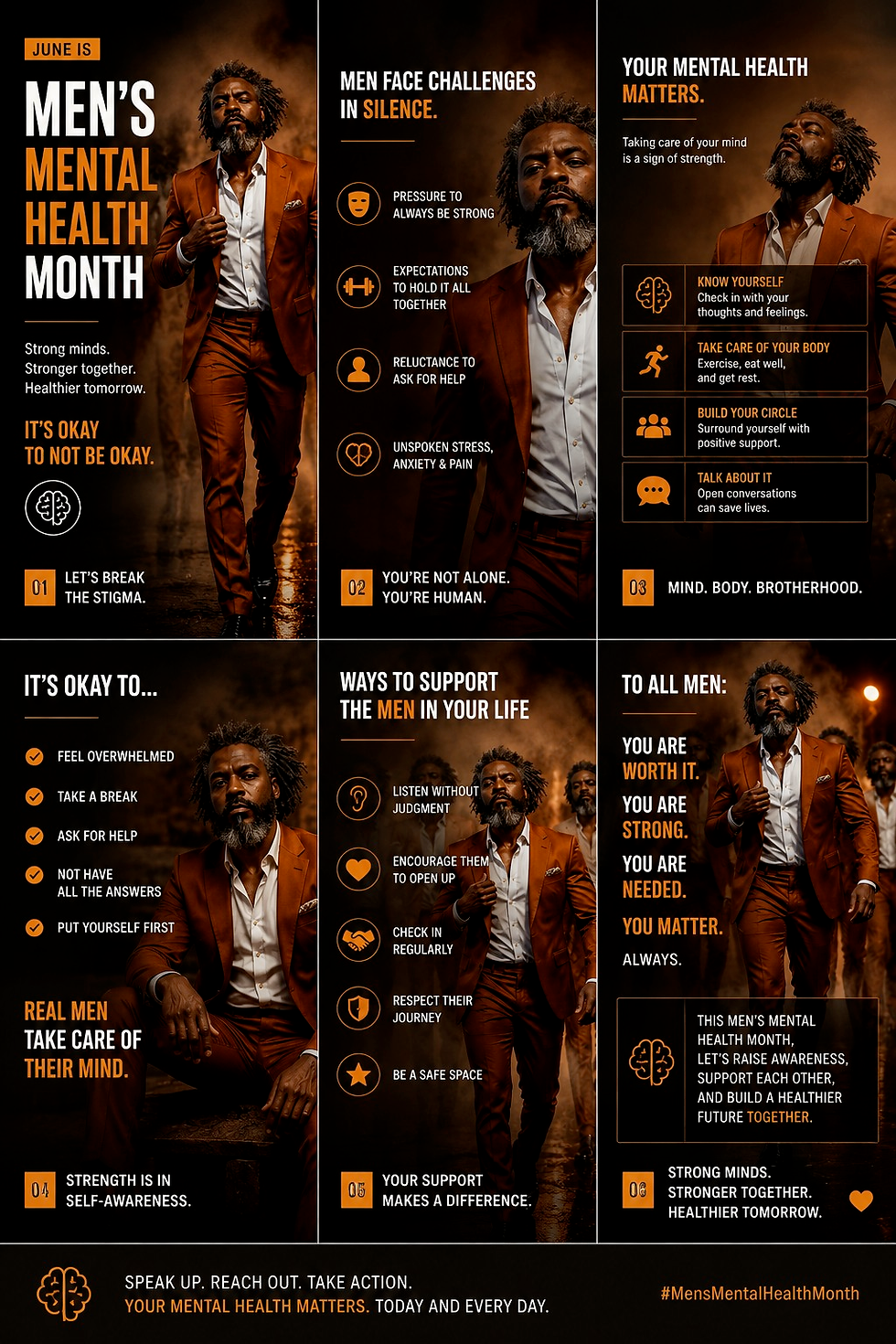
The Most Dangerous Lie Many Men Were Taught Was Not "Do Not Cry." It Was "Carry It Alone."
June is Men's Mental Health Month.
Yet perhaps the most important conversation we need to have is not about mental health it is about inheritance. Not the inheritance measured in money, property or possessions. The inheritance measured in beliefs, behaviours, coping mechanisms and emotional habits passed from one generation to the next.
Look closely at the image above and you begin to see a story that stretches far beyond one individual. What appears to be a campaign about wellbeing is actually a reflection on culture, identity and the invisible burdens many men carry throughout their lives. Behind every statistic sits a father, a son, a brother, an uncle, a husband, a colleague or a friend who has learned, often from an early age, that strength means carrying the weight alone.
For many Black men across the UK, the Caribbean, Africa and the United States, that lesson was never taught directly. Nobody gathered young boys together and instructed them to suppress their emotions. Nobody formally explained that vulnerability should remain hidden. Instead, those messages were absorbed through observation.
They were learned around kitchen tables, in workplaces, at sporting events, in places of worship and within communities where survival often depended upon resilience.
The irony is that many of these lessons were born from necessity.
History placed extraordinary demands upon previous generations. Families endured the legacy of enslavement, colonisation, segregation, migration, economic hardship and institutional discrimination. Opportunities were often limited. Resources were scarce. Mistakes carried significant consequences. Under such conditions, perseverance became a survival strategy. Emotional restraint was frequently interpreted as discipline. Endurance became synonymous with strength.
These qualities helped countless families overcome immense challenges. They enabled communities to build businesses, create opportunities, purchase homes, educate children and establish legacies despite significant barriers. Without resilience, many of those achievements would not have been possible.
Yet there is an important distinction that modern mental health researchers increasingly encourage us to consider.
Survival skills are not always healing skills.
The characteristics that helped one generation navigate adversity may not be sufficient for addressing the psychological challenges facing the next. What protected our grandparents from immediate hardship does not necessarily equip their grandchildren to process anxiety, loneliness, burnout, identity struggles or emotional trauma.
That distinction may explain why conversations about men's mental health have become increasingly urgent.
The Silent Inheritance
One of the most significant discoveries emerging from contemporary mental health research is that trauma does not always travel through dramatic events. More often, it passes quietly through behaviours, attitudes and expectations.
Long before children understand concepts such as depression, anxiety or emotional regulation, they are already studying the adults around them. Every interaction becomes a lesson. Every response to stress communicates something about how emotions should be managed.
Researchers examining intergenerational trauma have found that children frequently inherit emotional patterns without explicit instruction. A young boy notices whether grief is discussed openly or ignored. He observes how disappointment is handled. He pays attention to reactions following loss, rejection, failure or conflict. Over time, these observations shape his understanding of masculinity, resilience and emotional expression.
Within many Black communities, this process is often influenced by historical realities that extend far beyond individual families. Scholars have long argued that the psychological effects of systemic inequality do not disappear when circumstances improve. Experiences of discrimination, exclusion and economic insecurity can influence parenting styles, family dynamics and community expectations across generations.
Psychologist Dr Thema Bryant has written extensively about the relationship between historical trauma and emotional wellbeing, highlighting how individuals can become highly skilled at functioning while carrying unresolved pain. Professional achievement may coexist with emotional exhaustion. Community leadership can sit alongside loneliness. Outward confidence sometimes masks internal struggle.
Research published by the Journal of Black Psychology has similarly explored the tension between resilience and emotional suppression within Black communities. Findings suggest that cultural expectations around strength and self-reliance can provide valuable protective factors while simultaneously creating barriers to help-seeking behaviours.
This creates a paradox that many mental health professionals now recognise with increasing frequency.
Men often become highly skilled at functioning within circumstances they have never fully processed emotionally. They continue meeting expectations, fulfilling responsibilities and supporting those around them. Careers advance, households are maintained and obligations are met.
To colleagues, friends and even family members, life may appear stable and successful. Yet beneath that outward competence, unresolved stress, grief, disappointment or trauma can remain unaddressed for years, quietly shaping behaviour, relationships and overall wellbeing without ever being openly acknowledged.
Perhaps the most important lesson from this body of research is that inheritance is not destiny. Every generation has the opportunity to examine the stories it has received and decide which beliefs should be carried forward and which require revision.
Resilience remains essential. Responsibility remains admirable. Discipline remains valuable. Yet genuine wellbeing may require expanding our definition of strength to include self-awareness, emotional intelligence and the willingness to seek support when needed.
Why This Conversation Matters Now
Mental health researchers increasingly believe we are witnessing a significant transition in the lives of men across both the UK and US.
Previous generations largely measured success through stability. Secure employment, home ownership and financial provision formed the foundation of identity for many households.
Contemporary realities are considerably more complex. Technological disruption, economic uncertainty, changing social expectations and shifting definitions of masculinity are creating new pressures that previous generations rarely encountered.
Consequently, the conversation is no longer simply about whether men are struggling. The more important question concerns the forces driving those struggles.
When researchers examine current evidence, several interconnected patterns emerge repeatedly. Each trend influences not only mental health but also physical wellbeing, family relationships, career progression, financial stability and community cohesion.
These are the five trends we cannot afford to ignore.
Five Trends We Cannot Ignore
Trend One: Men Are Talking More, But Often Only After Crisis
One of the most encouraging developments over the past decade has been the growing visibility of conversations surrounding men's mental health. Athletes, business leaders, entertainers and community advocates are increasingly speaking about anxiety, depression, burnout and emotional wellbeing. Subjects that previous generations often considered private are now appearing in mainstream media, workplaces and public discourse.
Visibility, however, should not be confused with accessibility.
Research from the Mental Health Foundation and the Samaritans continues to show that many men delay seeking support until emotional distress has already reached a critical point. Rather than addressing concerns when they first emerge, intervention frequently occurs after relationships have deteriorated, physical health has suffered or professional performance has been affected.
Within Black communities, additional barriers often complicate this pattern. Studies examining mental health engagement among Black men in both the UK and US have identified concerns relating to stigma, cultural expectations, mistrust of institutions and fears of being misunderstood. Seeking help can sometimes feel like a challenge to deeply ingrained beliefs about resilience and self-sufficiency.
The result is a troubling paradox.
Conversations about mental health have become more visible than ever before, yet many men still find themselves speaking only when circumstances become impossible to manage alone. What begins as stress may evolve into anxiety. Emotional exhaustion may become burnout. Temporary difficulties can gradually transform into long-term challenges that affect every area of life.
The lesson here is not simply that men need to talk more. Rather, society must create environments where those conversations can happen earlier, before difficulties become crises.
Trend Two: Financial Pressure Is Becoming A Mental Health Issue
For generations, many men built their sense of identity around provision. Employment represented far more than a source of income. Work offered structure, purpose, social status and a tangible demonstration of responsibility. Success was often measured by one's ability to provide security for family and loved ones.
Today's economic landscape has fundamentally altered that equation.
Across the UK and US, technological disruption, artificial intelligence, automation, rising housing costs and economic uncertainty are reshaping labour markets at a pace few anticipated. Occupations once considered stable now face significant transformation. Entire industries are being redefined. Traditional career pathways are becoming less predictable.
Research conducted by institutions including the Institute for Fiscal Studies and the Brookings Institution highlights growing concerns around financial insecurity, particularly among middle-income households. Economic stress has increasingly become linked to anxiety, poor sleep quality, reduced wellbeing and relationship strain.
For Black men, these pressures are often compounded by longstanding wealth disparities. Reports from the United Kingdom's Race Disparity Unit and studies examining racial wealth gaps in the United States consistently show that Black families possess significantly less accumulated wealth than their White counterparts. Fewer financial reserves often mean reduced protection during periods of economic disruption.
Consequently, financial pressure is no longer simply an economic issue. It has become a psychological issue, influencing self-esteem, identity, confidence and mental wellbeing. When society continues to measure masculinity through provision while simultaneously making economic security harder to achieve, many men find themselves navigating impossible expectations.
Trend Three: Loneliness Is Emerging As A Silent Epidemic
Perhaps one of the most surprising findings emerging from contemporary wellbeing research concerns loneliness.
Contrary to popular assumptions, loneliness is not simply the absence of people. Many individuals are surrounded by colleagues, family members, social networks and online communities while experiencing profound feelings of isolation.
The distinction lies between contact and connection.
The renowned Harvard Study of Adult Development, one of the longest-running studies on human wellbeing, has repeatedly demonstrated that strong relationships remain among the most significant predictors of happiness, health and longevity. Similar conclusions have emerged from research undertaken throughout the United Kingdom.
Despite these findings, many men continue to struggle with meaningful emotional connection. Conversations may occur daily, yet discussions about fear, disappointment, uncertainty or vulnerability remain uncommon. Social interactions often revolve around work, sport, politics or current events while deeper emotional experiences remain hidden.
Black academics studying community wellbeing have also noted the impact of migration, changing family structures and declining community cohesion. Institutions that once provided support, including local organisations, neighbourhood networks and extended family systems, have weakened in many areas. As a result, some men find themselves carrying significant emotional burdens without trusted spaces in which to share them.
Loneliness is increasingly being recognised as a public health issue rather than merely a social concern. Studies have linked chronic social isolation to increased risks of depression, cardiovascular disease, cognitive decline and premature mortality. The challenge therefore extends far beyond emotional discomfort. It affects both quality and length of life.
Trend Four: Black Men Face Additional Trust Barriers
Conversations about mental health often focus on individual behaviour while overlooking the broader systems in which people operate.
For many Black men, decisions about seeking support are shaped not only by personal beliefs but also by lived experiences. Research conducted across healthcare, education and employment settings consistently demonstrates that experiences of bias, discrimination and unequal treatment influence trust in institutions.
Scholars including Dr Shaun Harper and numerous Black researchers examining race and wellbeing have highlighted the cumulative impact of racial stress on psychological health. Although individual incidents may appear small in isolation, repeated experiences of stereotyping, exclusion or unfair treatment can create a significant emotional burden over time.
Studies examining healthcare engagement in both the UK and US have identified concerns regarding cultural competence and representation within mental health services. Some individuals report feeling misunderstood, misdiagnosed or reluctant to disclose personal experiences due to fears that cultural contexts may not be fully recognised.
Trust therefore becomes a critical factor in wellbeing.
Without trust, even the most effective services struggle to engage those who need them most. Building culturally responsive systems is not simply a diversity objective. It is a public health necessity that directly influences outcomes for individuals, families and communities.
Trend Five: Community-Based Solutions Are Showing Promise
Amid these challenges, there is also reason for optimism.
A growing body of evidence suggests that some of the most effective approaches to supporting Black men's mental health originate within communities themselves. Researchers increasingly recognise that healing often occurs most effectively in environments where people feel safe, understood and respected.
Across the UK, the Caribbean, Africa and the US, community-led initiatives are demonstrating encouraging results. Barbershops, faith-based organisations, mentoring programmes, sports clubs and peer-support networks are helping to reduce stigma while creating opportunities for meaningful conversations.
These settings possess advantages that formal institutions sometimes struggle to replicate. Shared cultural experiences create familiarity. Trust develops more naturally. Participants often feel less judged and more willing to engage honestly.
Research examining community-based interventions has found that culturally relevant programmes improve participation rates and increase the likelihood of individuals seeking support before reaching crisis point. Such findings reinforce an important truth. People are more likely to engage when they feel seen, heard and understood.
Perhaps this explains why brotherhood remains such a powerful force for transformation.
Human beings were never designed to carry every burden alone. Progress occurs through connection. Growth accelerates through support. Healing becomes possible when individuals recognise that vulnerability does not diminish strength but enhances it.
What Real Strength Looks Like
The message behind Men's Mental Health Month is not that men should become less resilient. Resilience remains one of the most admirable qualities any person can possess. Throughout history, resilience has enabled individuals, families and communities to overcome extraordinary adversity.
The opportunity before us is not to abandon resilience but to redefine it.
For too long, strength has often been interpreted as silence. Endurance has been mistaken for wellbeing. Emotional suppression has been confused with self-control. Many men have been praised for carrying burdens that no human being was ever meant to carry alone.
A healthier definition of strength recognises that courage takes many forms. Sometimes it involves persevering through difficulty. On other occasions, it involves acknowledging that support is needed. Emotional intelligence requires honesty about what is happening internally rather than maintaining the appearance that everything is under control.
Leadership is not demonstrated through exhaustion. Wisdom is not measured by the amount of pain concealed from others. Character is not diminished by vulnerability.
Healthy masculinity creates space for accountability, reflection, growth and connection. It recognises that seeking help is not evidence of weakness but a commitment to wellbeing. It understands that resilience and openness can coexist.
Most importantly, it acknowledges that future generations are watching. Every conversation between fathers and sons matters. Why the example set by mentors matters and why every opportunity to challenge outdated assumptions matters. The lessons we pass forward will shape how the next generation understands manhood, relationships, success and wellbeing.
BrothaTalk Conversation
Perhaps the most important question raised by this discussion is not what previous generations taught us, but what we intend to teach those who follow.
If a young man were learning about masculinity from your life alone, what lessons would he take away about strength, resilience and emotional wellbeing?
Would he learn that success requires silent suffering?
Would he conclude that vulnerability should be hidden?
Or would he discover that true strength includes self-awareness, meaningful connection and the confidence to seek support when necessary?
Join the conversation below and share your perspective. Your experience, insight or reflection may help another brother realise that he is not alone in what he is carrying.

If this article resonated with you, please like, comment and share it with your network. Every conversation helps challenge stigma, strengthen communities and create a healthier legacy for future generations.
#YouBelongHere #BrothaTalk #MensMentalHealthMonth #BlackMenMatter #MentalWealth #Leadership #Wellbeing #Purpose #Community #Legacy
Source: Andre Frazier


Comments